
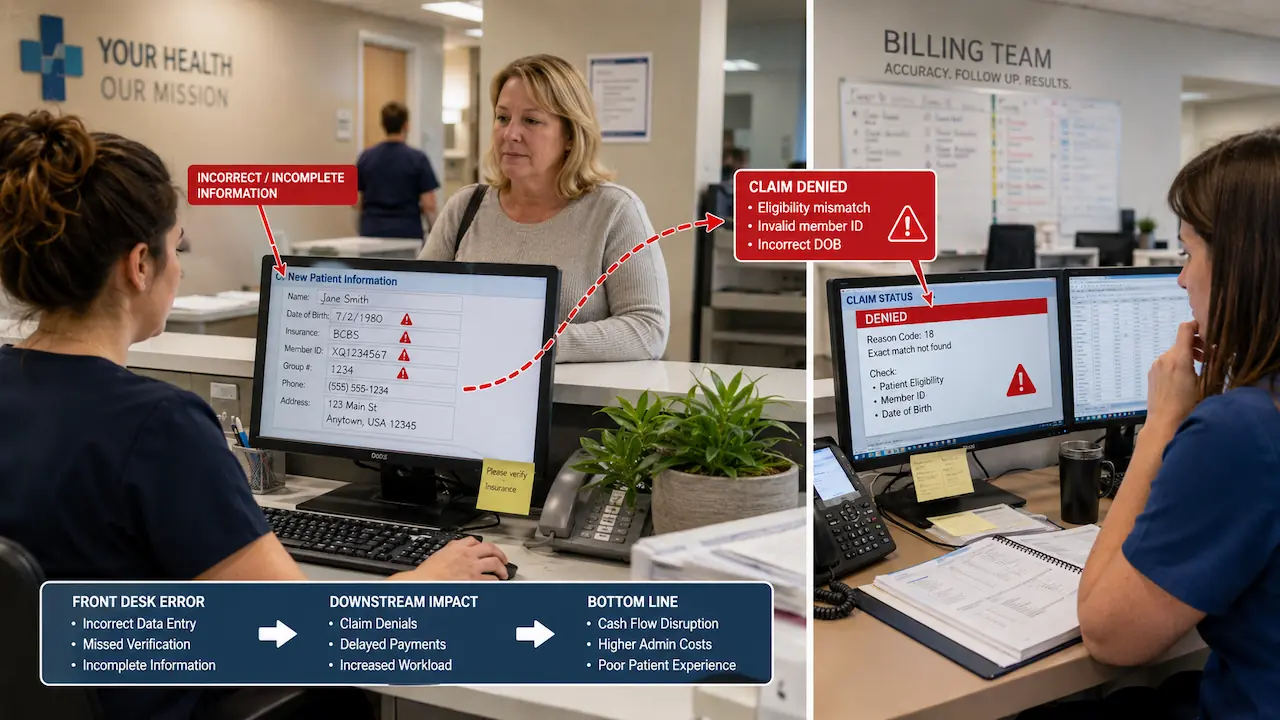
Many denials that appear to be billing problems begin at registration. Wrong member IDs, outdated insurance cards, incorrect payer order, missing referrals or unverified authorization requirements can follow the claim all the way to denial.
The solution is not to turn front-desk staff into billers. It is to define a small set of revenue-critical data points and escalation rules.
Demographic and subscriber accuracy
Confirm legal name, DOB, member ID, group, subscriber relationship and contact information against current payer data.
Insurance changes
Ask about new coverage and capture both sides of current insurance cards where the practice workflow requires it.
Payer order
Identify primary, secondary and tertiary coverage correctly. Escalate Medicare secondary, accident or other complex situations rather than guessing.
Network and benefit checks
Active coverage should be translated into provider/location network status and relevant service benefits.
Referral and authorization handoff
The front end should know which visits can be scheduled immediately and which require referral/authorization review before service.
Documentation trail
Record verification date, source and key findings so billing can understand what was known at the time of service.
A practical review checklist
- Verify patient/subscriber identity.
- Capture current insurance.
- Confirm payer order.
- Check network and service benefits.
- Flag referral/authorization needs.
- Document verification evidence.
Give the front desk a short escalation playbook
Staff should know what to do when coverage is inactive, the patient presents a new plan, payer order is unclear, the provider appears out of network, a referral is missing or authorization cannot be confirmed. The correct response is often escalation—not guessing and not simply telling the patient that insurance “will not pay.”
Use scripts that explain uncertainty respectfully. For example, staff can state that coverage information is being verified and that final responsibility depends on payer processing, rather than promising a specific payment outcome.
Audit front-end defects by downstream impact
When billing identifies a denial caused by registration or verification, feed the issue back with enough detail to improve the workflow. Track repeat defects by type and location. The purpose is coaching and prevention, not blame.
How practice leaders can operationalize the findings
The first step is to establish a baseline before changing the workflow. Export the relevant claim, payment, denial, aging or front-end data and define the period being reviewed. Record how the current metric is calculated so the practice can compare the same measure after changes are introduced.
Second, assign ownership by root cause. Revenue-cycle problems often cross departments: the front desk may own demographics and eligibility; authorization staff own approval tracking; coders review documentation and code selection; billing owns claim construction and submission; posting owns remittance application; denial and AR teams own unresolved balances. A problem without a named owner becomes an aging problem.
Use exception-based management
Leadership does not need to inspect every routine claim. Build exception reports for high-dollar balances, repeated denial reasons, claims approaching deadlines, unusual adjustments, unresolved payer delays and accounts that have not moved after prior follow-up. This concentrates management attention where financial risk is highest.
Close the loop upstream
When a claim is recovered, ask whether the underlying defect was corrected. If an authorization denial was overturned but the scheduling workflow still fails to capture authorization requirements, the same loss will recur. Recovery and prevention should be reported separately so the practice can see both immediate financial impact and long-term process improvement.
Keep reporting transparent
Monthly reporting should explain material changes in collections and AR. If a prior-period payment is reversed, duplicated posting is corrected, or a balance is adjusted, the change should remain visible rather than being hidden by a new total. Transparent reconciliation gives practice owners a more reliable picture of performance.
Review again after 30 days
After the first improvement cycle, compare the new data with the baseline. Look for fewer repeat defects, faster claim movement, clearer ownership and reduced high-risk aging. If the numbers did not improve, investigate whether the intervention addressed the real root cause or only changed the way activity was recorded.
Continue with Provider Insights