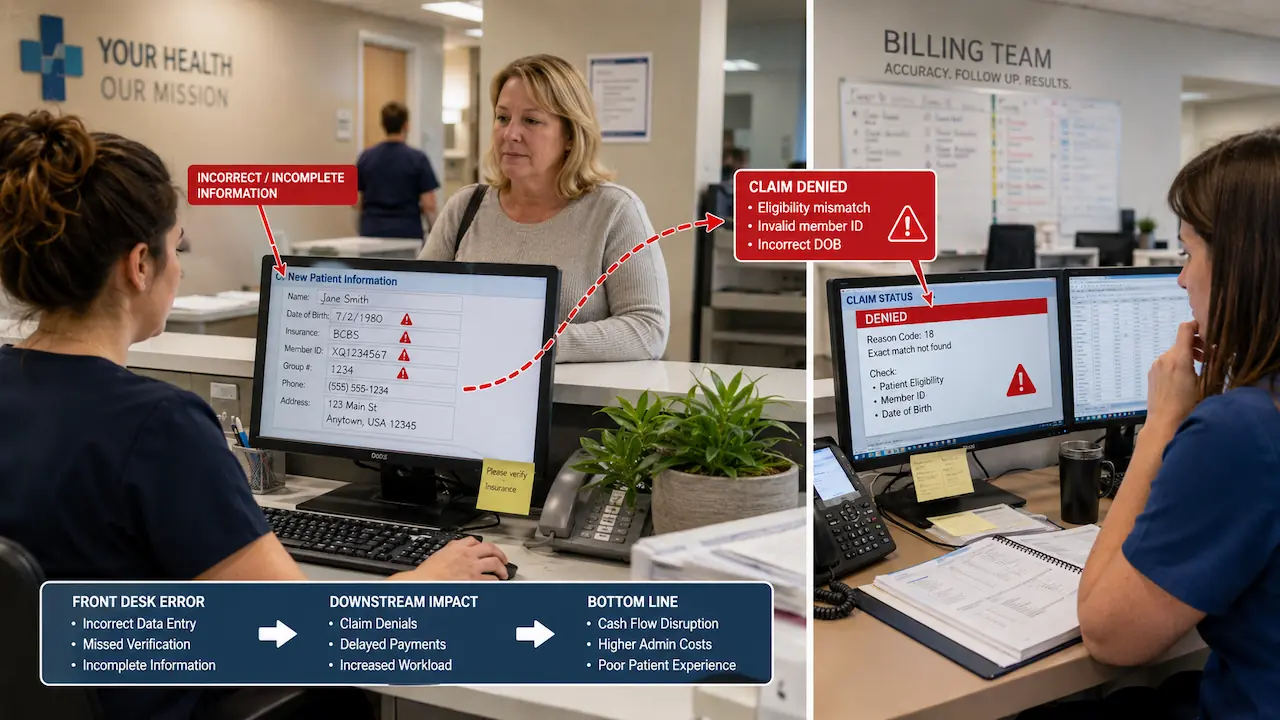

New practices often focus correctly on clinical readiness: staffing, space, equipment, scheduling and patient access. Revenue-cycle readiness deserves the same pre-launch discipline because many billing problems are created before the first claim is ever submitted.
The goal is not to make every workflow perfect before opening. It is to establish ownership, payer readiness, minimum data standards and a controlled path from appointment to final payment.
Payer enrollment and credentialing
Create a payer matrix showing submitted, pending, approved and effective dates. Do not assume every payer is ready because one major plan has approved the provider.
Front-end eligibility and authorization
Define who verifies benefits, how far in advance, which services require deeper benefit review, who obtains authorization and how approval details reach billing.
Coding and documentation
Build specialty-specific charge workflows, coding responsibility, documentation completion expectations and a process for questions before claims are released.
Claim submission and rejection control
Establish daily claim batches, clearinghouse acceptance review, rejection ownership and turnaround expectations.
Payment posting and reconciliation
Set up ERA/EFT where appropriate, define posting controls, manage unapplied cash and reconcile reversals or recoupments.
AR and denial work queues
Define when unpaid claims enter follow-up, how denials are categorized, how high-dollar claims are prioritized and how deadlines are tracked.
Leadership reporting
Decide before launch which metrics leadership will review weekly and monthly: charges, submitted claims, payments, denials, aging, payer delays and unresolved issues.
A practical review checklist
- Complete payer readiness matrix.
- Define eligibility/authorization ownership.
- Test charge and claim workflows.
- Confirm clearinghouse acceptance process.
- Configure ERA/EFT and posting controls.
- Create denial and AR queues.
- Define weekly/monthly leadership reports.
Run a pre-launch revenue-cycle simulation
Before the first patient day, walk one hypothetical encounter through the entire system: scheduling, registration, eligibility, authorization, documentation, coding, charge creation, claim generation, clearinghouse transmission, remittance, posting, patient balance and reporting. The exercise often reveals missing ownership that individual setup checklists do not show.
Repeat the simulation for a high-risk service such as a procedure requiring authorization or a patient with secondary insurance. Confirm that the team knows where evidence is stored and how billing receives it.
Plan the first 90 days as a stabilization period
New practices should expect real payer behavior to reveal issues that testing cannot. Review rejections daily, denials weekly and aging/collections at least monthly. Correct configuration and training quickly before a small defect is repeated across hundreds of encounters.
How practice leaders can operationalize the findings
The first step is to establish a baseline before changing the workflow. Export the relevant claim, payment, denial, aging or front-end data and define the period being reviewed. Record how the current metric is calculated so the practice can compare the same measure after changes are introduced.
Second, assign ownership by root cause. Revenue-cycle problems often cross departments: the front desk may own demographics and eligibility; authorization staff own approval tracking; coders review documentation and code selection; billing owns claim construction and submission; posting owns remittance application; denial and AR teams own unresolved balances. A problem without a named owner becomes an aging problem.
Use exception-based management
Leadership does not need to inspect every routine claim. Build exception reports for high-dollar balances, repeated denial reasons, claims approaching deadlines, unusual adjustments, unresolved payer delays and accounts that have not moved after prior follow-up. This concentrates management attention where financial risk is highest.
Close the loop upstream
When a claim is recovered, ask whether the underlying defect was corrected. If an authorization denial was overturned but the scheduling workflow still fails to capture authorization requirements, the same loss will recur. Recovery and prevention should be reported separately so the practice can see both immediate financial impact and long-term process improvement.
Keep reporting transparent
Monthly reporting should explain material changes in collections and AR. If a prior-period payment is reversed, duplicated posting is corrected, or a balance is adjusted, the change should remain visible rather than being hidden by a new total. Transparent reconciliation gives practice owners a more reliable picture of performance.
Review again after 30 days
After the first improvement cycle, compare the new data with the baseline. Look for fewer repeat defects, faster claim movement, clearer ownership and reduced high-risk aging. If the numbers did not improve, investigate whether the intervention addressed the real root cause or only changed the way activity was recorded.
Continue with Provider Insights